

NLWeb
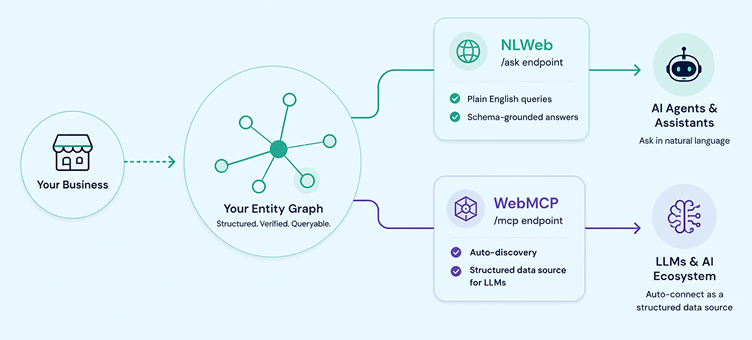
Your site becomes queryable in plain English via the /ask endpoint. Users and AI agents can ask natural language questions about your business and receive structured, accurate answers drawn directly from your entity graph.
Call us at +1-408-200-2211 or fill the form below
*Required Files
Your privacy and security are a top priority. We will not distribute or sell your personal information to any third parties. Please visit our privacy policy page to contact us to review or delete data collected.
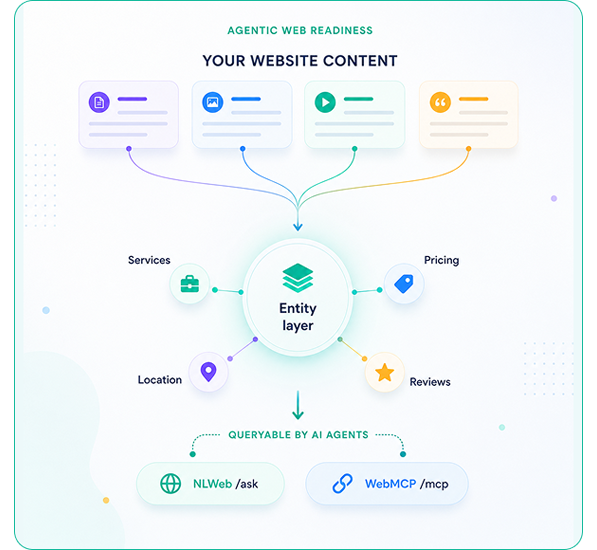
Milestone Schema Manager does not require rebuilding your website or replacing your content. We take the content you already have across your website and make it interpretable and accessible to the emerging AI ecosystem.
Your overall website content remains the primary evidence layer

Identify and structure every entity using human-engineered rules
Connect entities via @id into a detailed, traversable entity graph
Schema.org elements, NLWeb endpoint, and WebMCP for agent-readiness
The next phase of AI is not just about answering questions. It is about agents completing tasks for users: finding a service, checking availability, making a booking, getting a quote. To do that reliably, they prefer structured, machine-readable entity data over interpreting unstructured content every time.
The real shift: language models read your content to build general knowledge, but agents need a structured, queryable entity layer to act. Milestone Schema Manager builds both from the content you already have, understanding your whole website, identifying the entities within it, and forming them into a connected entity layer exposed through Schema.org, NLWeb, and WebMCP.



Today's AI search mostly answers questions. The agentic web is the next phase, where AI agents complete tasks on a person's behalf: finding a service, checking availability, getting a quote, making a booking. The shift moves your business from being something an engine describes to something an agent interacts with, which rewards structured, callable data over content an agent has to interpret.
Read more in the AI Visibility Guide: Ch 1 The End of Clicks
Both are true, and that is the point. Task-completing agents are still maturing, but the data foundation they will require, clean entities, consistent definitions, queryable endpoints, takes time to build well. Businesses that structure now are simply ready when capability arrives, the same way entity authority compounds quietly before it pays off. Waiting for the agentic web to be obvious means starting the foundation late.
Read more in the AI Visibility Guide: Ch 7 Automation, Governance, and TCO
A language model reads content to build general knowledge and produce an answer. An agent needs structured, reliable, queryable data to take an action with confidence, because a wrong attribute means a wrong booking or quote. Reading tolerates ambiguity; acting does not. Structured entity data and defined endpoints are what bridge the gap between being understood and being transacted with.
Read more in the AI Visibility Guide: Ch 4 Schema Myths Debunked
NLWeb exposes your entities to plain-language questions through an ask endpoint, while WebMCP applies the Model Context Protocol so authenticated AI assistants can connect to your entity graph as a structured data source. They sit on top of the entity foundation you already build rather than requiring a separate rebuild, so the heavy engineering is in the structured data, not in standing up new infrastructure for each protocol.
Read more in the AI Visibility Guide: Ch 7 Automation, Governance, and TCO
No. Access is governed, not open. WebMCP connections are authenticated, so only authorized agents can query your graph, and the data they receive is the verified record you maintain rather than inferred guesses. In practice this increases brand control, because agents act on the facts you publish instead of scraping and interpreting unstructured pages.
Read more in the AI Visibility Guide: Ch 6 The Trust Layer | Ch 8 Omnichannel Dependence (SSOT)
It is the same foundation, exposed. The connected, verified entity graph that makes you citable in AI answers is the exact asset that agents query. Agentic readiness is largely about making that graph accessible through structured endpoints, which is why doing the entity work first means agentic readiness is an extension rather than a new project.
Read more in the AI Visibility Guide: Ch 3 Building the AI Grounding Layer
Outcomes track the entities you expose. A hospitality brand can let agents check availability and book, an automotive dealer can surface inventory and offers, a lender can return eligibility and product detail, and a healthcare provider can guide care navigation. In each case the value comes from structured, accurate attributes the agent can act on directly, which is what turns AI presence into completed transactions.
Read more in the AI Visibility Guide: Ch 1 The End of Clicks | Ch 4 Schema Myths Debunked
Your privacy and security are a top priority. We will not distribute or sell your personal information to any third parties. Please visit our privacy policy page to contact us to review or delete data collected.
Call us at +1-408-200-2211 or fill the form below
*Required Files
Your privacy and security are a top priority. We will not distribute or sell your personal information to any third parties. Please visit our privacy policy page to contact us to review or delete data collected.