
Call us at +1-408-200-2211 or fill the form below
*Required Files
Your privacy and security are a top priority. We will not distribute or sell your personal information to any third parties. Please visit our privacy policy page to contact us to review or delete data collected.
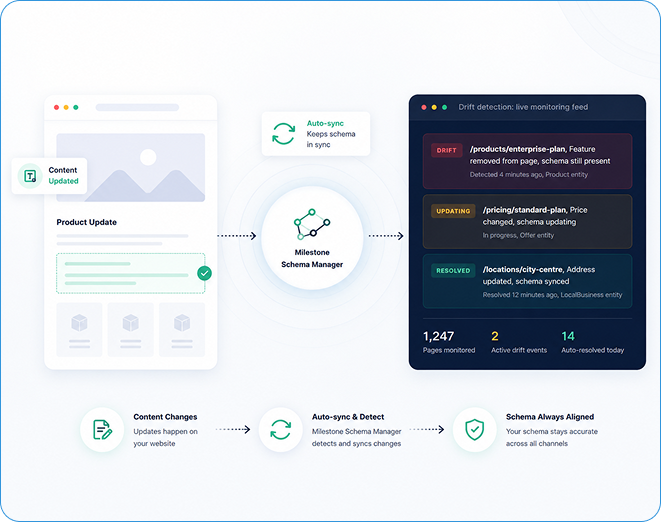
Entity drift detection and auto-sync with Milestone Schema Manager keep your structured data aligned as your content evolves. Content changes are inevitable: a price updates, a product is removed, an address changes. Each one opens a gap between what your page says and what your schema declares, and that drift erodes your entity authority with AI engines.
Milestone Schema Manager monitors your pages continuously. When a change affects entity data, the schema is flagged or auto-synced, at the point of content save for CMS-integrated deployments. Every channel keeps drawing from one verified entity graph, so inconsistency cannot accumulate.
Schema drift is the growing gap between what a page says and what its structured data still declares: a price that changed, a product that was removed, an address that moved. It begins the moment content changes and schema does not. Drift turns into contradictions that AI engines surface directly to customers, and because engines weigh consistency heavily, even a few stale properties can lower the trust they need to cite you. Left unmanaged, it compounds across the site.
Read more in the AI Visibility Guide: Ch 10 Data Validation | Ch 7 Automation, Governance, and TCO
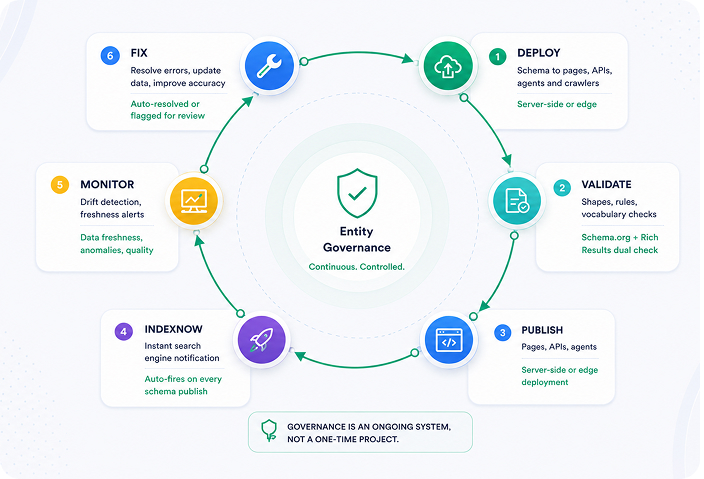
Because a website is never static. Every content change is a chance for valid schema to drift into missing properties, outdated values, or broken structure, and a launch-day check cannot catch a problem that appears six months later. Continuous validation treats governance as an ongoing system: deploy, validate, publish, notify, monitor, fix, and repeat. One-time validation protects launch day and nothing after it.
Read more in the AI Visibility Guide: Ch 7 Automation, Governance, and TCO | Ch 10 Data Validation
The competitive metric is citation share: how often your brand is referenced relative to rivals in AI answers for the queries that matter to you. Pairing it with AI presence rate, the percentage of relevant queries where your entity appears at all, shows both your absolute reach and your position against competitors. Together they reframe visibility from where you rank to how often AI engines choose you over the alternatives.
Read more in the AI Visibility Guide: Ch 9 Measuring Influence
It should measure influence inside AI answers, not just positions on a results page. A complete AI-era report covers AI presence rate, citation share, intent alignment so citations appear where they convert, rich result performance, schema-attributed traffic, and the paid search spend displaced as organic AI visibility grows. Rankings still matter, but they no longer tell the whole story of how discoverable you are.
Read more in the AI Visibility Guide: Ch 9 Measuring Influence
By attribution and displacement. Every deployment can be timestamped so performance shifts are tied to specific structured data changes rather than guessed at. Displacement quantifies the paid search spend you no longer need because organic AI citations and rich results now capture high-intent queries, which translates visibility directly into avoided cost. That links the entity investment to a number finance recognizes.
Read more in the AI Visibility Guide: Ch 9 Measuring Influence
Governance is most often an ownership problem before it is a data problem, so the answer is a defined owner over a single authoritative record rather than each team maintaining its own version. A governed entity layer gives every channel one source to draw from, which is what prevents the website, listings, and AI citations from quietly contradicting each other. The owner maintains that source; the system enforces it.
Read more in the AI Visibility Guide: Ch 8 Omnichannel Dependence (SSOT) | Ch 7 Automation, Governance, and TCO
Measurement combines connected search and AI surfaces with structured monitoring of where your entities appear, rather than relying on a single dashboard that does not yet exist for every engine. Presence and citation signals are tracked across the surfaces that can be measured, and tied back to timestamped schema changes. The scope is tailored to what each surface exposes, which is why measurement is framed as influence rather than a simple rank number.
Read more in the AI Visibility Guide: Ch 9 Measuring Influence